
HR and Talent Leaders Predict the Top 5 Workforce Challenges of 2026



For organizations and the people responsible for building their workforces, 2025 was a year defined by constant recalibration. Rapid change, economic pressure, evolving skill demands, and accelerating AI adoption collided with hiring freezes, reorganizations, and a widespread return to the office. Talent leaders were asked to do more with less, often lacking the support and structure to navigate these changes.
As we enter 2026, the question isn’t whether change will continue, it’s how organizations will build the capability to keep up. Hiring, selection, and reskilling strategies are no longer support functions; they’re business-critical levers for stability, performance, and growth.
To understand what lies ahead, we surveyed 1,500 respondents, primarily HR and L&D leaders, about the most anticipated workforce challenges of 2026. While continued change topped the list, the data also revealed something encouraging: Optimism about the future and a renewed focus on building stronger, more human-centered organizations.
Here are the top five challenges talent leaders expect to face in 2026—and what they mean for selection and development strategies.
1. Change Isn’t Slowing Down: Talent Agility Matters More Than Ever
It’s no surprise that 66% of respondents anticipate even more change in 2026. Market shifts, new technologies, and evolving business models are now the norm, not the exception.
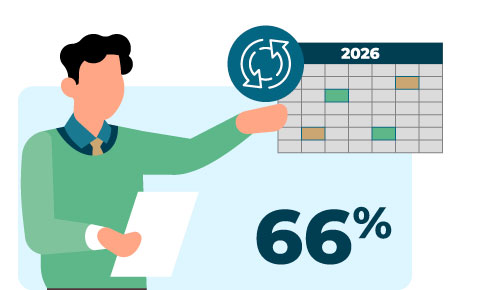
66% anticipate more change in 2026.
Many respondents reported limited confidence in their organization’s ability to adapt, even while feeling personally optimistic about their future at the company. That gap points to a critical opportunity: hiring and developing people with the behavioral traits, cognitive ability, and motivational fit to navigate uncertainty. In organizations impacted by hiring freezes and financial challenges, reskilling and training is imperative to equipping your people with the tools they need to succeed, and to also ensure the stability of your bottom line.
In an era of constant change, organizations can no longer afford selection decisions based solely on experience or gut instinct. Predictive insights into adaptability, problem-solving, and learning agility help leaders build teams that can flex as the business evolves.
2. Organizational Culture Struggles Are Rooted in Talent Decisions
Culture took a significant hit in 2025, and it shows. From budget constraints to reduced investment in development, many organizations unintentionally weakened the systems that help people feel connected, supported, and successful.

30% report organizational culture improvement as a top challenge for 2026.
Culture doesn’t just show up in values statements—it’s reinforced every time someone is hired, promoted, or placed into a role without the tools to succeed. When employees are stretched into positions without the right behavioral fit or skill foundation, stress increases and engagement drops.
2026 presents a reset opportunity: using data-driven selection and targeted development to place people where they can perform, grow, and contribute meaningfully. Stronger role fit leads to better performance—and a healthier culture as a result.
3. Communication Gaps Start Earlier Than We Think
Communication remains the most critical leadership skill, with 64% of respondents identifying it as essential. Yet communication challenges often emerge long before someone becomes a people manager.
64% report communication as the most important leadership skill.
When organizations hire or promote without understanding how individuals naturally communicate, respond to feedback, or handle conflict, misalignment is almost inevitable, especially during periods of change. The result? Employees feel change is happening to them rather than with them.
Using behavioral insights during selection and development allows organizations to identify and prepare future leaders who can communicate with clarity, empathy, and transparency—skills that are indispensable when navigating uncertainty.
4. Technology Training Imperative to Success
AI and emerging technologies dominated conversations in 2025. In 2026, the focus shifts from adoption to execution. 35% of respondents identified learning technology as a top challenge.
35% report learning technology as a top challenge.
Technology only creates value when people know how to use it effectively. That requires understanding not just skill gaps, but learning preferences, motivation, and readiness to reskill.
Strategic reskilling starts with insight. When organizations understand who is best positioned to learn, adapt, and apply new tools, they can invest development dollars where they’ll have the greatest impact—without losing sight of the human side of work.
5. Optimism Is High, but Engagement Lags
Despite a turbulent year, 73% of respondents reported feeling optimistic about their organization’s future. At the same time, 30% identified employee engagement as a top challenge.

30% of HR and L&D leaders identify employee engagement as a top challenge.
This disconnect highlights a pivotal moment for talent leaders. Optimism creates momentum, but engagement requires intentional action. People are more likely to stay engaged when they feel understood, well-matched to their roles, and supported in their growth.
Hiring for fit, developing with purpose, and aligning people to roles where they can succeed turns optimism into performance—and reduces the risk of burnout and turnover along the way.
Turning Talent Insight into Action in 2026
If 2025 reinforced anything, it’s that workforce decisions have long-term impact. As organizations face another year of change, investing in smarter hiring, more strategic selection, and targeted reskilling is one of the most effective ways to create stability while still moving forward.
When you understand your people, you can build teams that don’t just survive change but thrive in it.
When everything around you is changing, the one constant you can count on is understanding your people. PXT Select® assessments give you the data-driven insights to see who adapts quickly to change, who needs more support during transitions, and how to position each person for success even when priorities keep shifting. This isn't just about managing change, it's about using change as an opportunity to build high-performing teams.
Wiley Workplace Intelligence conducts in-depth research on key workplace issues by gathering insights from individual contributors, managers, and leaders. Wiley Workplace Intelligence then analyzes these findings to provide actionable solutions that are shared in our blog.
Did You like This Content?
Join our newsletter to get insights,
updates and more!