
Why Career Development Still Depends Too Much on Guesswork



Recall your latest development conversation with your manager. For many people, it probably felt more like a quick check-in than a meaningful discussion about where their career is headed. Most managers want to help their people grow, yet career development remains surprisingly difficult to deliver consistently. The intent is there. What’s often missing is a reliable way to turn that intent into action.
New research from Wiley Workplace Intelligence surveyed 1,459 individuals about career pathing to understand what helps development conversations lead to growth and what causes them to stall. We explored the tools managers use, how well they understand their people, and where assessments fit into the picture.
The findings point to a clear, solvable challenge, and some encouraging news about how quickly organizations can make progress.
Managers Are Building Development Plans from Scratch
According to our research, most managers are left to figure out their own approach to development, and many aren’t using a formal process at all.

Only 29% of managers use formal, company-provided development tools.
In contrast, 37% of managers rely on informal, self-built methods, and 26% use no development tools. When organizations don’t provide a shared framework for development, every manager is left to define the process for themselves, deciding how to identify potential, discuss growth, and support career progression. Some will navigate these conversations effectively. Others will rely largely on instinct. As a result, employees’ development experiences vary dramatically depending on who they report to.
Managers Know Themselves Better than They Know Their Team
A formal process can create consistency, but development starts with understanding the person sitting across from you.
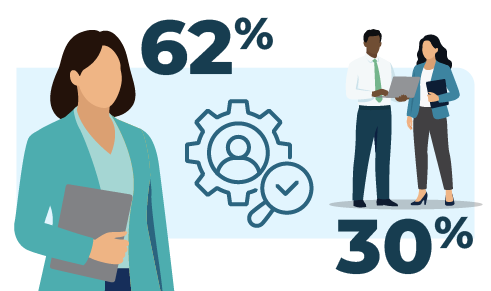
Only 62% of managers understand their own strengths, vs. 30% for their team.
That difference matters because effective coaching depends on knowing how someone works, what motivates them, and where they have room to grow. Without that understanding, managers naturally default to their own experience as a reference point. Career conversations can still happen, but they end up shaped by observation and educated guesses rather than a complete picture of the employee. The intentions are good, but that kind of guidance doesn’t always land the way it’s meant to.
This is where assessments can play an important role, providing insight that helps managers better understand their people long before major development decisions are made.
Hiring Assessments Have a Long Reach
The value of an assessment doesn’t end when a hiring decision is made. In many organizations, the insights gathered early on continue to support employee growth long after they join the team.

Only 42% of assessed at hire employees feel clear on their career path, vs. 29% who weren’t.
Career path clarity is easier to build when managers already understand how someone works, communicates, and responds to feedback, which is exactly the kind of insight most managers say they lack. Assessment data gives them that starting point before day one, so coaching conversations can be personalized from the first conversation instead of pieced together through trial and error. For many employees, this early snapshot becomes the reference point managers return to in later development conversations.
What Leaders Can Do
Taken together, these findings point to a few practical ways organizations can make development more consistent, personalized, and effective.
Give managers a starting point. Development doesn't need to be complicated, but it does need structure. A simple, consistent framework is more effective than asking every manager to create their own approach.
Use assessment data to close the awareness gap. Assessments like PXT Select®, give managers clearer insight into how each employee works, communicates, and grows, making development conversations more personalized and effective.
Build assessment into hiring, not just performance reviews. Employees assessed at hire report greater career clarity later on. Starting early gives managers and employees a foundation they can build on overtime.
Make development tools the standard, not the exception. Frameworks, assessments, and coaching resources should be part of every manager's toolkit, not something only a few teams have access to.
None of this requires managers to become development experts overnight. It requires organizations to give them better tools and clearer insights into their people. The organizations that close the development gap won't be the ones asking managers to try harder. They'll be the ones equipping managers to coach with confidence from the start.
Underneath all these findings is the same idea, job fit. Whether managers have a formal process, understand their team's strengths, or gain insight before day one, it all comes down to knowing how well someone's thinking style, behavioral traits, and interests match what their role demands. PXT Select®'s job fit feature measures exactly that, giving managers an objective, shared foundation for every development conversation that follows.
Wiley’s suite of professional solutions gives organizations a shared language and structure to reach the next level, from making confident hiring decisions with PXT Select®, building better teams with The Five Behaviors®, to creating engaged, adaptive cultures with Everything DiSC® on Catalyst™, and unlocking leadership potential with 360 feedback from The Leadership Challenge®.
Wiley Workplace Intelligence conducts in-depth research on key workplace issues by gathering insights from individual contributors, managers, and leaders to deliver actionable solutions through our blogs.
Did You like This Content?
Join our newsletter to get insights,
updates and more!